

Webhooks
Kinetix Webhooks lets your customers subscribe their own endpoints to platform events. You declare the subscribable events and fire() them; Kinetix delivers a signed (HMAC), queued, retried and logged request to every active subscriber — and validates customer URLs against SSRF.
Installation
php artisan vendor:publish --tag=kinetix-webhooks-migrations
php artisan migrate'webhooks' => [
'enabled' => env('KINETIX_WEBHOOKS_ENABLED', false),
// auto = spatie/laravel-webhook-server when installed, else the native job.
'driver' => env('KINETIX_WEBHOOKS_DRIVER', 'auto'),
'teams' => env('KINETIX_WEBHOOKS_TEAMS', false),
// Permit private/loopback URLs — dev/testing only (SSRF risk in production).
'allow_private' => env('KINETIX_WEBHOOKS_ALLOW_PRIVATE', false),
'timeout' => env('KINETIX_WEBHOOKS_TIMEOUT', 10),
'tries' => env('KINETIX_WEBHOOKS_TRIES', 3),
'retention_days' => env('KINETIX_WEBHOOKS_RETENTION_DAYS', 30),
],Deliveries run on the queue — make sure a worker is running.
1. Declaring & firing events
Declare the subscribable events in a service provider, then fire them from your domain code:
use Happones\Kinetix\Webhooks\KinetixWebhooks;

// Provider boot()
KinetixWebhooks::events([
    'order.created' => 'Order created',
    'order.shipped' => 'Order shipped',
]);

// Anywhere in your app
KinetixWebhooks::fire('order.created', ['id' => $order->id, 'total' => $order->total]);
Only registered events can be subscribed to or fired. Firing queues a signed delivery to each active endpoint subscribed to that event (in the current team scope).
Firing outside a team's request
fire() reads the team from the request. A queued job, a console command or a model event that runs without one would reach the platform's endpoints (those with no team) instead of the customer's. Name the team with fireFor(): a team model or key, or null for the platform's endpoints:
// A model event: the order's team, whichever request (or job) created it.
KinetixWebhooks::fireFor($order->team_id, 'order.created', ['id' => $order->id]);
With webhooks not team-scoped, every endpoint belongs to the platform and the team is ignored.
2. The customer dashboard
Mount <KinetixWebhookManager> behind the webhooks.manage ability — customers register endpoints, pick events, rotate the secret, send a test event and inspect delivery logs:
<script setup lang="ts">
import KinetixCan from '@/components/kinetix/KinetixCan.vue'
import KinetixWebhookManager from '@/components/kinetix/KinetixWebhookManager.vue'
</script>

<template>
  <KinetixCan permission="webhooks.manage">
    <KinetixWebhookManager />
  </KinetixCan>
</template>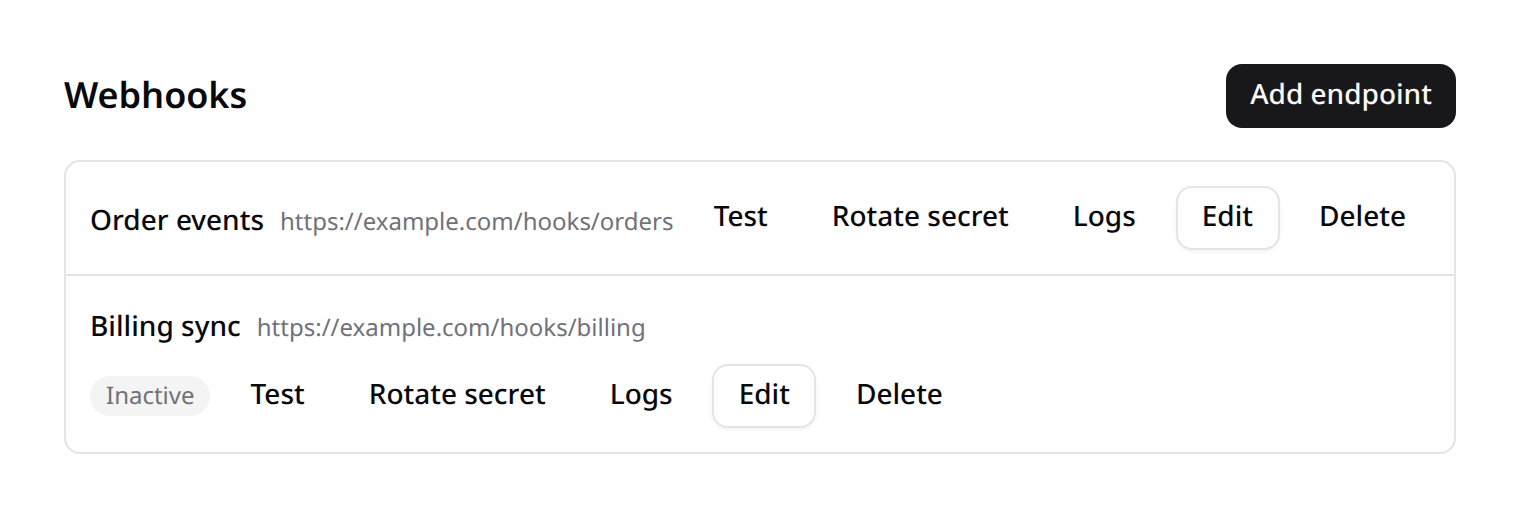
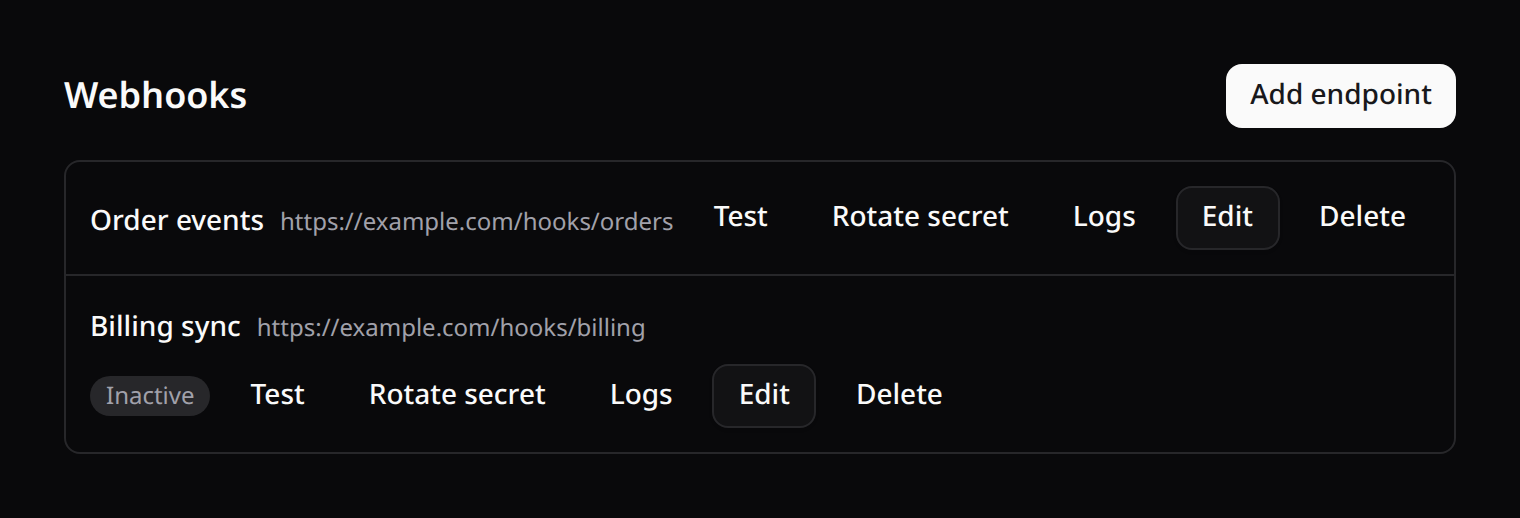
The signing secret is shown exactly once (on create and rotate) and never returned again.
3. Verifying signatures (customer side)
Each delivery carries X-Kinetix-Event and an X-Kinetix-Signature — hash_hmac('sha256', rawBody, secret). The receiver verifies it:
$expected = hash_hmac('sha256', $request->getContent(), $endpointSecret);

abort_unless(hash_equals($expected, $request->header('X-Kinetix-Signature')), 403);
The body is {"event": "...", "data": { ... }}.
4. Security & reliability
SSRF protection: customer URLs are validated (
WebhookUrlGuard) at save time and again before each delivery — non-HTTP(S) schemes and hosts resolving to private / loopback / link-local / reserved IPs (incl. cloud metadata169.254.169.254) are rejected. Setallow_private = trueonly locally.Retries: failed deliveries (non-2xx or transport error) retry on the queue with backoff (
tries, default 3). Every attempt is logged.Retention: schedule
kinetix:webhooks:prunesokinetix_webhook_logsstays bounded:phpSchedule::command('kinetix:webhooks:prune')->daily();
The delivery log
No extra setup: logging is always on with the module, for both delivery drivers (native job and spatie's webhook-server, which is bridged per attempt). The kinetix_webhook_logs table ships inside the same kinetix-webhooks-migrations publish tag. Each entry records the event, the sent payload, the response body, status code, success flag and attempt number — browse them per endpoint in the dashboard or across endpoints with <KinetixIntegrationLogs>.
Two knobs (both optional):
'webhooks' => [
    'log_payloads'   => true,   // store the sent payload with each entry
    'response_limit' => 1000,   // max stored response-body characters
],
Set log_payloads = false when your events carry sensitive data — entries then keep everything except the payload (redelivery from old entries won't be possible without it).
5. Testing your webhooks
Point an endpoint at a request-catching service to watch deliveries land in real time — webhookcatcher.com gives you a throwaway URL and shows the headers, signature and payload of every request, which is ideal for verifying your signature check. (webhook.site is a common alternative.)
Create an endpoint with that URL, hit Test in the dashboard (or call KinetixWebhooks::fire(...)), and inspect the captured request. For a local catcher, set KINETIX_WEBHOOKS_ALLOW_PRIVATE=true so the SSRF guard permits it.
6. Endpoints
Team-aware, under the Kinetix route prefix, gated by webhooks.manage:
| Method | Endpoint | Description |
|---|---|---|
GET | {prefix}/webhooks | List endpoints + available events |
POST | {prefix}/webhooks | Create (returns the secret once) |
PUT | {prefix}/webhooks/{endpoint} | Update |
DELETE | {prefix}/webhooks/{endpoint} | Delete |
POST | {prefix}/webhooks/{endpoint}/rotate | New signing secret |
POST | {prefix}/webhooks/{endpoint}/test | Queue a test delivery |
GET | {prefix}/webhooks/logs | Delivery logs across all endpoints (?result=, ?search=) |
GET | {prefix}/webhooks/{endpoint}/logs | Delivery logs |
POST | {prefix}/webhooks/logs/{log}/redeliver | Re-queue a delivery |
7. Delivery driver
With driver = auto (default), Kinetix delivers through spatie/laravel-webhook-server when it's installed — inheriting its tuned retries/backoff — and falls back to the native queued job otherwise. Force either with driver = 'spatie' / 'native'.
Either way the dashboard delivery logs are populated and the SSRF guard runs before every delivery. Two driver-specific differences to know:
- Signature header: the native driver sends
X-Kinetix-Signature; the spatie driver uses spatie'sSignatureheader (configurable viaconfig('webhook-server.signature_header_name')). Both are HMAC-SHA256 of the raw body — verify against whichever your driver sends. - Retries/timeout: with the spatie driver these come from spatie's own config (
webhook-server.tries/timeout_in_seconds), notkinetix.webhooks.*.
Kinetix logs spatie's per-attempt outcomes by listening to its WebhookCallSucceeded/WebhookCallFailed events (correlated by a meta tag), so your dashboard stays consistent across drivers.